
China’s Pinglu Canal: A New Gateway to Malaysian Trade
- IRS

- Jun 6
- 6 min read
For over half a century, the dream of a direct river-to-sea connection in Southwest China remained just that a dream. However, as of June 2026, that vision has materialized into 134.2 kilometers of concrete, steel, and sophisticated hydraulic engineering. Often hailed as China’s "Project of the Century," the Pinglu Canal is now entering its final testing phase, preparing to redraw the trade maps of Southeast Asia and beyond.
A Shortcut Through Geography
The Pinglu Canal is the first major river-to-sea canal constructed in China since the founding of the People’s Republic in 1949. Stretching from the Xijin Reservoir on the Yu River in Nanning, it follows a southward path to the Qin River estuary, eventually emptying into the Beibu Gulf (Gulf of Tonkin).
For civil engineers and logistics planners, the primary "raison d'être" of this project is the correction of a geographic inefficiency. Previously, cargo from China’s landlocked southwestern provinces (such as Yunnan and Guizhou) had to detour eastward through the Pearl River system in Guangdong to reach global markets.
Technical Specs and World Records
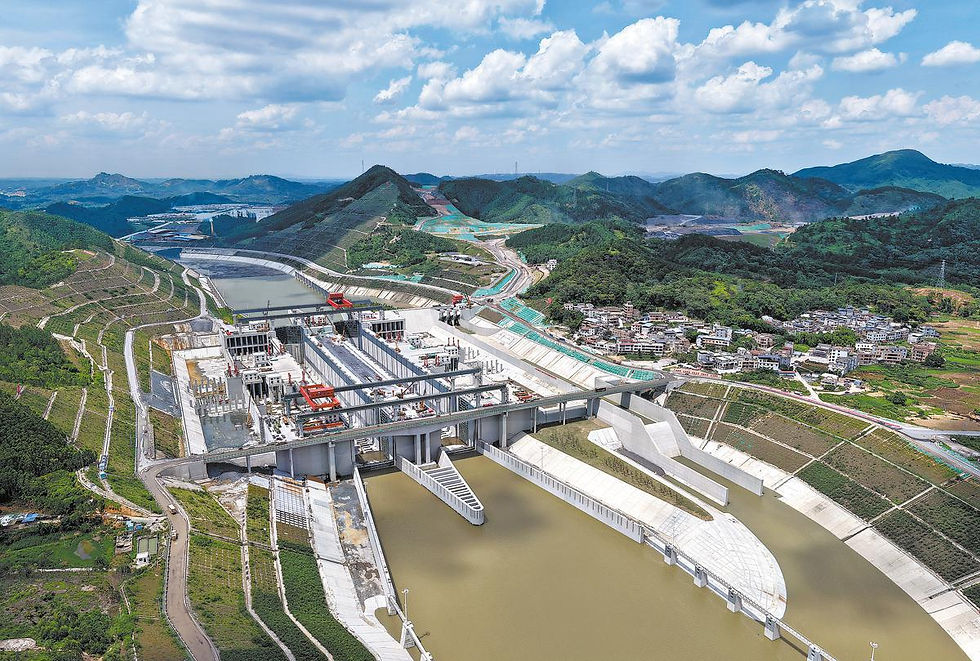
From an engineering standpoint, the Pinglu Canal is a masterclass in modern infrastructure. Designed to accommodate 5,000-metric-ton vessels (equivalent to 100 railway wagons per ship), the waterway must overcome a significant vertical challenge: a total elevation drop of 65 meters (about 213 feet) between the inland reservoir and the ocean.
To manage this, the project utilizes three major navigation hubs: Madao, Qishi, and Qingnian. These hubs function as "water elevators," employing massive ship locks to raise and lower vessels.
Sustainability in the "Green Canal"
Beyond pure mechanics, the Pinglu Canal is a test case for "green" mega-infrastructure. The project includes ecological conservation areas designed to preserve oxbow-lake habitats and old river bends. A standout feature is the fish passage at the Qingnian hub, which uses sensors and cameras to monitor and assist migrating aquatic life, ensuring the man-made barrier does not disrupt natural ecosystems.
Project Status: The Final Countdown

Construction, which began in August 2022, has moved at a blistering pace. On June 3, 2026, the canal achieved a critical milestone: full-channel water filling. With over 96% of the project complete, it has now entered the commissioning and testing phase. Trial voyages are slated for July and August, with the grand opening ceremony scheduled for the China-ASEAN Expo in September 2026, three months ahead of the original timeline.
PROJECT TRIVIA

The Grand Scale
134.2 Kilometers: The total length of the canal, stretching from the Xijin Reservoir to the Beibu Gulf. This is roughly equivalent to the straight-line distance from Hong Kong to Guangzhou.
560 Kilometers: The massive detour the canal eliminates for cargo traveling from inland China to the sea.
20,000 Workers & 5,000 Machines: The scale of the labor force and equipment fleet that has been working around the clock to meet the 2026 deadline.
72.7 Billion Yuan (RM43.32 Billion): The total planned investment for the project, making it one of China's most significant modern infrastructure investments.
Engineering & Technical Trivia
World’s Largest Water-Saving Lock: The Madao Hub features a ship lock with a maximum lift of 29.6 meters equivalent to the height of a 9 or 10-story building.
Olympic-Sized Precision: The lock chambers at Madao are 300 meters long and 34 meters wide, large enough to handle multiple 5,000-tonne vessels simultaneously.
Lightning-Fast Gates: Despite their massive size, the lock gates at the Qishi and Madao hubs are designed to open in just one minute and close in a mere 30 seconds.
65 Meters: The total elevation drop the canal must navigate from the inland reservoir to the ocean, which is roughly the height of a 20-story building.
100 Railway Wagons: One single 5,000-tonne vessel capable of traversing the canal carries as much cargo as a train with 100 wagons.
27 Bridges: The project involves the construction or rebuilding of 27 bridges to allow road and rail networks to cross the new waterway.
Economic & Logistics Trivia
5.2 billion Yuan (RM3.1 billion): The estimated annual savings in logistics costs for the region once the canal is fully operational.
740 Kilometers: The total reduction in shipping distance specifically between China's inland western provinces and Malaysia.
18% to 30%: The projected drop in logistics costs for shippers, which will significantly improve capital turnover and reduce inventory pressure.
10 Million TEUs: The milestone container throughput reached by the Beibu Gulf Port in 2025, which the Pinglu Canal is expected to further boost.
Environmental Trivia
36 Ecological Conservation Areas: The number of dedicated zones established along the canal to protect river bends, habitats, and oxbow lakes.
1,575-Foot Fish Passage: A specialized channel at the Qingnian hub that uses sensors and cameras to help fish migrate past the canal’s infrastructure.
Three-Tier Water Saving: The canal utilizes a world-first engineering solution (a three-tier, overlapping water-saving basin system) to minimize the amount of water lost during lock operations.
The Strategic Ripple Effect: Benefits for Malaysia
While the Pinglu Canal is a Chinese infrastructure project, its impacts will be felt most acutely across the ASEAN region, particularly in Malaysia. As China’s second or third largest trading partner within ASEAN, Malaysia stands to gain significantly from this "New International Land-Sea Trade Corridor".
Lower Landed Costs for Commodities: Inland provinces like Yunnan and Guizhou produce vast quantities of phosphate fertilizer, aluminum, and agricultural products. Previously, the "Guangdong premium" (the cost and time added by detouring through Guangdong ports) made these goods more expensive for Malaysian buyers. The canal removes this penalty, potentially lowering the price of essential raw materials imported by Malaysia.
Faster Access for Malaysian Exports: In reverse, Malaysian exporters of rubber, rice, and processed foods now have a lower-cost, high-speed gateway into China’s interior consumer markets. Shipping distances to the wider Southeast Asian region could be reduced by up to 740 kilometers, making Malaysian goods more competitive in western China.
Supply Chain Resilience: Shippers could see total logistics costs fall by 18% to 30%. For Malaysian carriers and logistics firms, the canal offers a more stable cargo base and a resilient alternative to traditional road and rail routes, improving capital turnover and reducing inventory pressure.
Enhanced Economic Integration: The canal strengthens the trade corridor between Southeast Asia and Southwest China, which saw trade volumes reach US$1 trillion in 2025. For Malaysia, this means deeper integration into one of the world’s most dynamic economic zones, facilitated by the most advanced inland waterway technology currently in existence.
As the water settles in the locks of the Madao Hub this September, the Pinglu Canal will officially transition from a feat of civil engineering to a heartbeat of global commerce, cementing a new era of connectivity between China’s hinterland and the shores of Malaysia.
REFERENCES:-
CGTN. (2026, June 3). China's Pinglu Canal achieves full water filling, Madao hub sets two world records..
Chen, M. (2026, June 4). China's first river-to-sea canal to ease passage to Asean members enters key test phase. The Star..
Chen, M., & Zhang, L. (2026, June 3). Nation's first river-to-sea canal enters key test phase. China Daily..
ECONEWS. (2026, March 24). China is building a massive 83-mile canal to transport goods directly from the interior to the sea, and the project's scale explains why half the world is watching it closely. Ecoticias..
Kok, Y. (2026, May 18). Guangxi's Pinglu Canal to boost growing trade between South-east Asia and China. The Straits Times..
Lim, Z. T. (2026, May 11). Pinglu Canal: Redrawing China-Asean trade routes. The Business Times..
Noh (Ed.). (2026, May 4). The Pinglu Canal: Why does China's latest "Project of the Century" matter? Our China Story..
VCA Editorial Team. (2026, May 15). China's $10 billion canal opens in September and rewrites the ASEAN trade map. Value Chain Asia..
Xinhua. (2026, June 4). 30 seconds to witness China's Pinglu Canal rise from nothing..
Zhang, W. (2026, June 3). China's first major canal linking inland waterways with sea achieves full water filling, set for full navigation in September. Global Times.


Comments